
 Driven by curiosity. Driving change
Research
Our research vision is founded in a new understanding of the Process Integration concept beyond the traditional definition of systematic methods for design with an emphasis on energy efficiency and environmental impact.
Our research interests in keywords
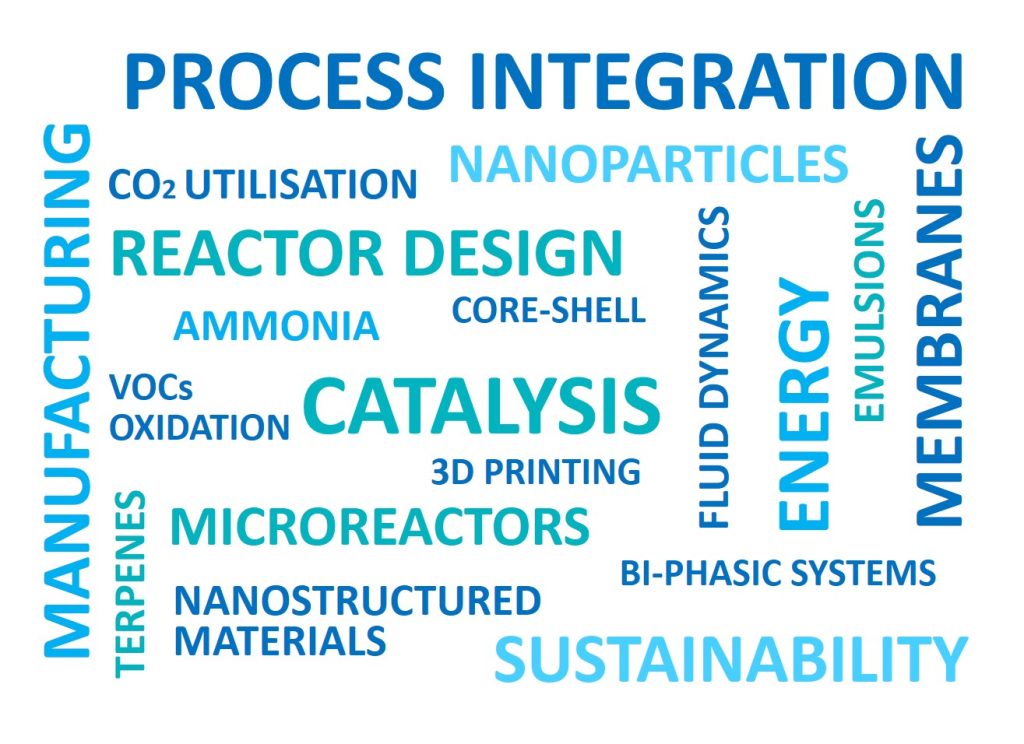
In the group, we are developing novel sustainable technologies by synergistically tackling several process challenges in an integrated way combining aspects of catalysis, reaction engineering, and separation.
Manufacturing of structured materials
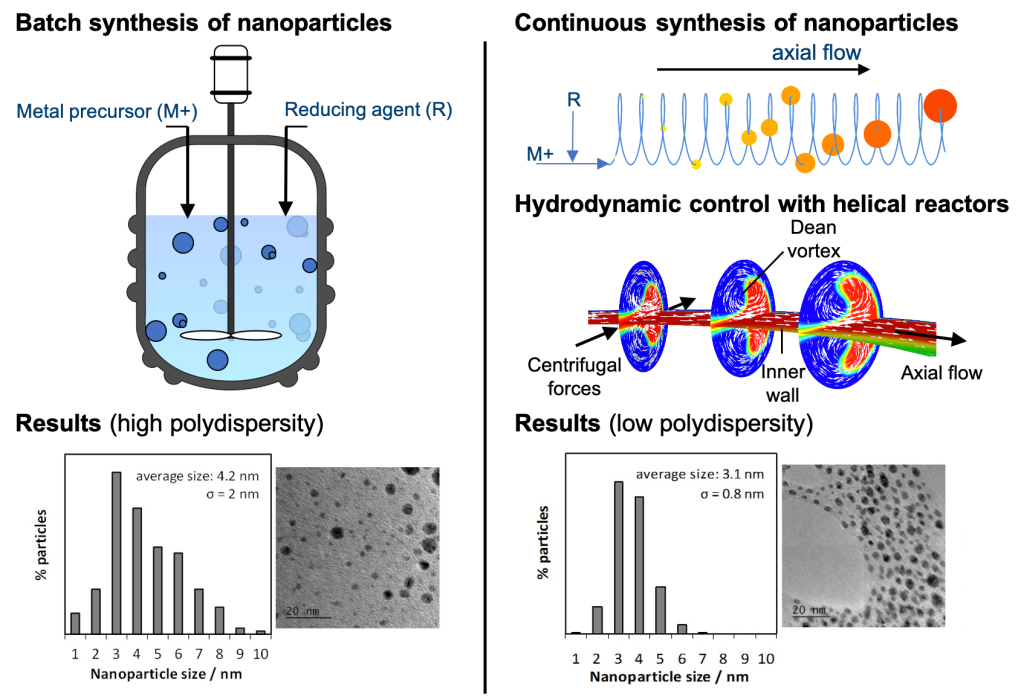
Metal nanoparticles present unique chemical and physical properties with a wide range of applications, including catalysis, drug delivery, sensors, energy storage, etc. However, the full realisation of these materials and their potential impact is hindered by the lack of a manufacturing technology capable of their production in a continuous and reproducible manner on a large scale.
Our vision is the development of novel manufacturing technologies based on microdevices for the continuous synthesis of metal nanoparticles with tailored compositions and tuneable sizes in the absence of capping ligands, which can potentially interfere with the final applications.
Kinetic studies of the nucleation and growth steps during the synthesis of different metal nanoparticles, coupled with computational fluid dynamics simulations, guide the design of novel microdevices with the aim of avoiding the sintering of the nanomaterials and controlling their final size.
The use of additive manufacturing technologies (3D printing) allows us to experimentally produce novel reactor configurations and obtain full control of the fluid dynamics within the channels, as well as to link experimental and simulation data to refine our models.
Sustainable energy
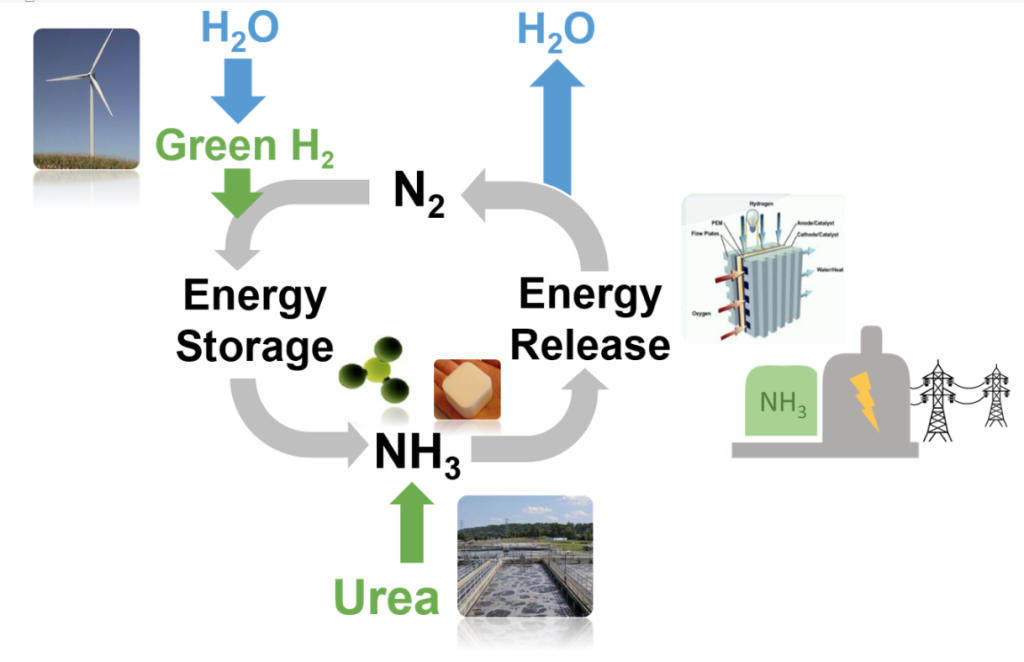
Achieving a fully renewable, clean energy landscape requires novel solutions for energy storage and recovery, and hydrogen shows promising potential. Our group is particularly interested in using ammonia (NH3) as a carbon-free hydrogen carrier to reduce hydrogen’s storage costs and manage its flammability. Ammonia contains a high hydrogen content of 17.65 wt%, well above the US Department of Energy target of 5.5 wt.% gravimetric capacity for a feasible energy vector.
Moreover, ammonia has an established distribution network and can be liquefied at far milder conditions than pure hydrogen. It can be synthesised from renewable sources by combining hydrogen from water splitting with nitrogen from the air, which makes it attractive for balancing seasonal energy demands through its intermittent renewable production. Alternatively, ammonia can be recovered from urea on farms and from municipal and industrial waste.
Our work involves studying and developing the full ammonia sustainable energy cycle, from generation using renewable sources or waste to distribution via existing infrastructure, storage, and final energy delivery
We are developing novel catalysts for low-temperature ammonia synthesis and decomposition through fundamental mechanistic understanding. We aim to replace the highly active state-of-the-art ruthenium catalysts with readily available metals or alloys. We are also investigating how to redefine the traditional Haber-Bosch ammonia synthesis process, as well as recover ammonia and urea from waste streams using novel adsorption materials.
Our vision is to develop novel manufacturing technologies based on microdevices for the continuous synthesis of metal nanoparticles with tailored compositions and tuneable sizes, without capping ligands that can interfere with final applications.
Kinetic studies of the nucleation and growth steps during the synthesis of different metal nanoparticles, coupled with computational fluid dynamics simulations, guide the design of novel microdevices to avoid sintering and control final size.
Additive manufacturing technologies (3D printing) let us experimentally produce novel reactor configurations, gain full control of fluid dynamics within the channels, and link experimental and simulation data to refine our models.
Waste to energy and fertilisers
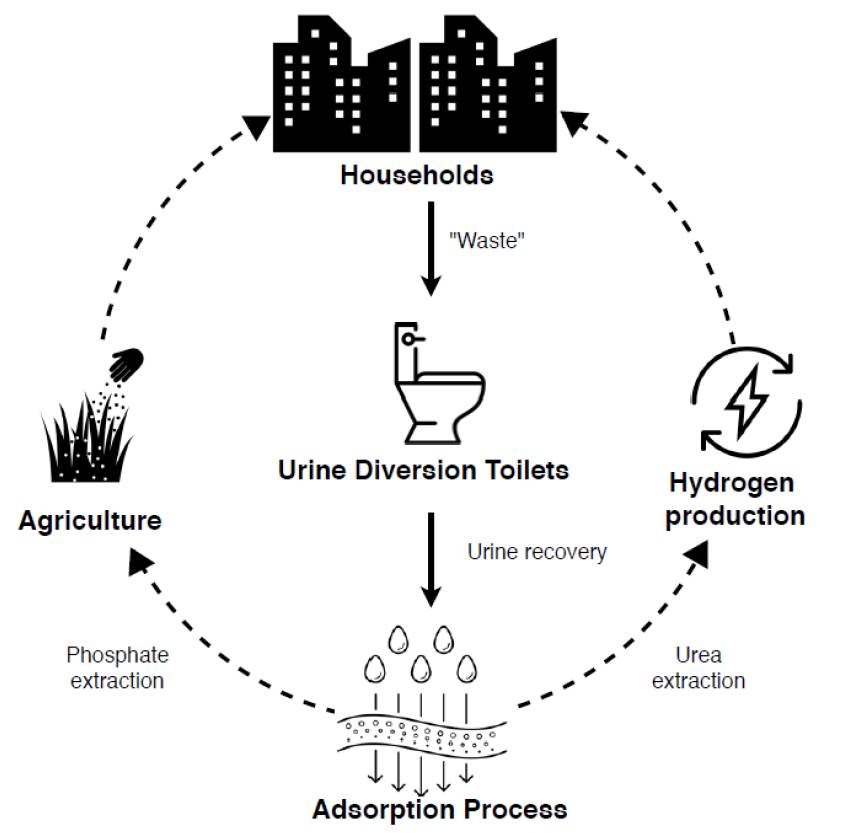
In the group, we are developing novel sustainable technologies by synergistically tackling several process challenges. One of these concerns is access to energy and water, which underpins the economic and social development of every country. The increasing demand for these two interrelated resources requires the development of new sustainable processes to decrease the energy consumed in the water cycle, especially during water treatment processes.
Wastewater streams contain a significant number of compounds that are currently considered pollutants. However, human wastes should be considered a critical resource that could be extracted and reused, with urine being an important one.
Despite being present in less than 1% of the total volume of domestic wastewater, urine contributes largely to all the nitrogen (~80%) produced, mainly in the form of urea ((NH2)2CO). Since urea is a hydrogen-rich compound (6.7 wt.%), it could be extracted from wastewater and then used for producing hydrogen as a source of green energy, reducing the energy demand of water treatment.
Additionally, urine also contributes significantly to all the phosphorus produced (~50%), mainly in the form of phosphate (PO43-). Extra value could be added to wastewater treatment by recovering phosphorus-based compounds, which can be later used as inorganic fertilisers.
The group is working on the development of technological processes for energy and nutrient recovery from wastewater streams. In particular, we are investigating adsorption as a technology that enables the removal of urea and phosphates from urine due to its great selectivity, simple operation, and high uptake capacity.
A new perspective that re-evaluates human waste as reusable and eco-friendly resources should be established, promoting the development of a circular economy in water treatment.
Sponsors
Our research would not be possible without our sponsors: