Driven by curiosity. Driving change
OBITUARY
In memory of Frank Ronald Goodwin Mitchell
by former colleague, Professor Allan Hayhurst, with thanks to Jim Thompson
Frank Ronald Goodwin Mitchell was a technical officer in the Department of Chemical Engineering –before the merger with the Institute of Biotechnology –in the 1960s. He was a popular member of staff in his time with the department, often lending his expertise and advice to research projects.
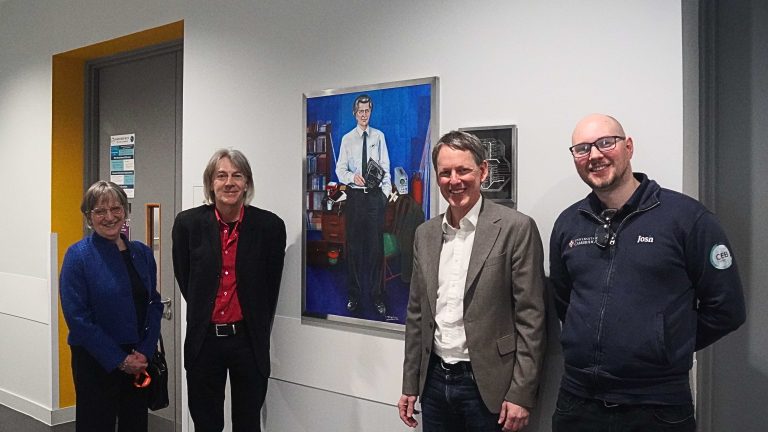
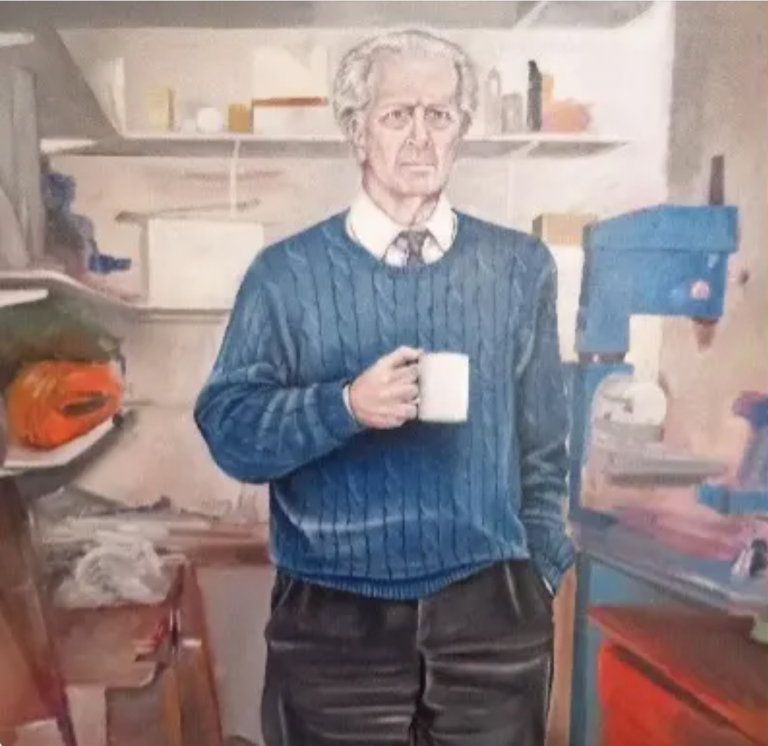
Ron, as he was known to friends and family, was born in Belfast in May 1932 and brought up there. He graduated locally from Queen’s University Belfast in 1953 with a degree in Electrical/Electronic Engineering. His portrait [above image], painted by son David, emphasises the seriousness with which he took his work but has omitted his friendly smile, which enabled him to work easily with others.
After graduation, he moved to England and married Patricia Constance Spong in 1954, with whom he had three children, Pamela, Carol and David. Initially he worked as an electrical engineer in Bristol at the Bristol Aeroplane Company, before moving to Chelmsford to work for Marconi and then to Northampton, where he worked at Plessey.
In 1963 the family moved to Cambridge, for him to become the Technical Officer in charge of the electronics workshop in Chemical Engineering. He worked with one technician and later with two of them. Their work varied from solving many minor electronics and wiring problems to designing and building very major pieces of equipment. One example was that in 1964 he started work on the first radio-frequency quadrupole mass spectrometer to be built in the U.K. It was a success. Nowadays, but not then, such a thing would not be novel, i.e. it can be readily bought. His work was not confined to electronic matters. For example, he contributed much to the design of a sampling system to enable a flame at over 2000 oC and atmospheric pressure to be sampled into a mass spectrometer at a pressure 109 times lower. That sampling system was later copied and used in the newly invented ICP – MS (inductively coupled plasma for mass spectrometry), an instrument much used nowadays by e.g. geologists for analysing rocks and minerals. These activities were considerably extended by the use of computers in experiments.
Given that the Department’s first computer arrived at the same time as Ron, the local tradition of developing new ways of doing novel experiments is a very strong one. Thus, Professor Chase writes: “Ron’s ingenuity, enthusiasm and willingness were extremely important in the creation of the interfaces between computers, and my chromatography equipment that was so critical for my research at that stage”. Examination of Ron’s publications shows the range of fields, in which he helped to invent and develop new equipment. Thus the radio-pill opened up fluidisation, not to mention studies of mixing. He was always modest about these achievements, which included a number of patents.
Ron took the degree of M.A. and was promoted at a time when that was much more difficult than now. He quickly turned out to be a key member of the Department, being one of its nicest, most competent, and reliable members. If you had a problem, whether it was an electronic one or not, you dropped in on Ron for a chat. Thus, one former member of the academic staff expressed his gratitude to Ron by saying that, but for Ron, some of his former students would not have received their doctorates. Ron worked his magic quietly in the Department until he retired in 1992 to look after his wife, who suffered with kidney disease and latterly needed frequent dialysis. She died in 2006.
Ron died in December 2021 at the age of 89. He had been in and out of hospital with various infections for some time and had also been diagnosed with Alzheimer’s.