
 Driven by curiosity. Driving change
Francis Thomas Bacon
While working at the Department of Chemical Engineering at Cambridge, prior to the merger with the Institute of Biotechnology, Bacon worked to create a functional version of the technology proposed a century before by Sir William Grove. The Bacon Fuel Cell works by combining hydrogen with oxygen in a redox reaction (a reaction where at least one component element loses electrons), which generates an electrical current.
This technology proved invaluable for the Apollo programme, as it presented a solution to the problem of generating electricity in space. Apollo 11 was already designed to carry Hydrogen and Oxygen onboard for fuel and life support, respectively. As a bonus, the only by-product of the redox reaction is drinkable water, suitable for the astronauts’ consumption.
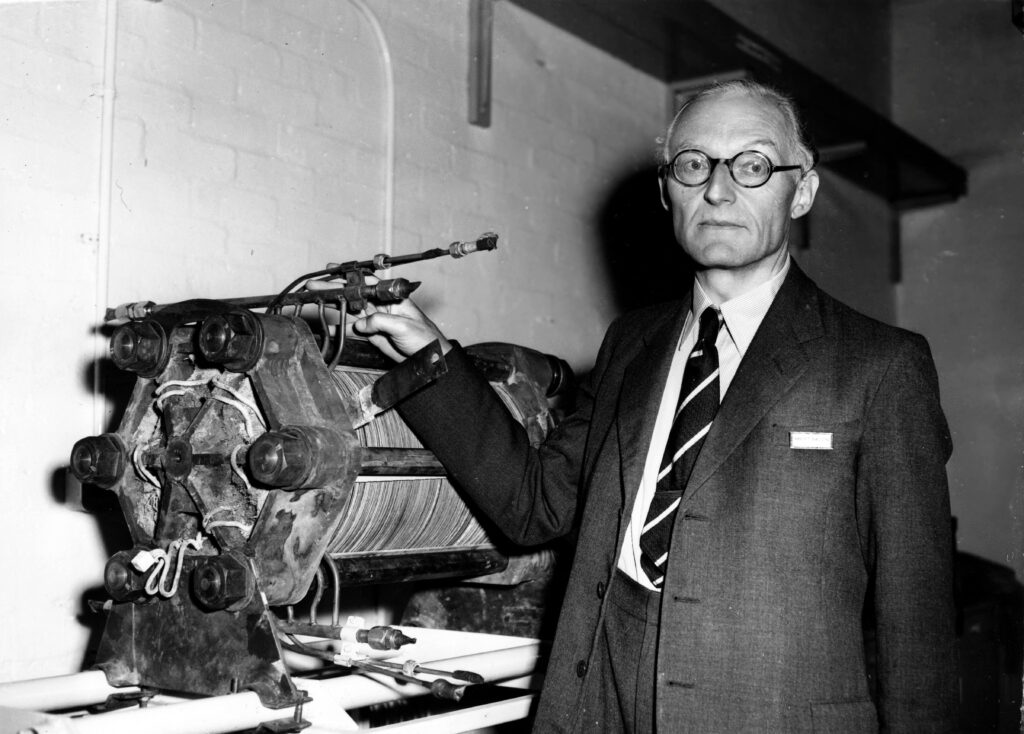
Born in Billericay in 1904, Bacon graduated from Trinity College Cambridge in 1925 after completing the Mechanical Sciences Tripos. He then spent years working in the private sector, before returning to Cambridge in 1946 armed with sponsorship from the Electrical Research Association.
Bacon and his team worked at the Department of Chemical Engineering (now the Department of Chemical Engineering and Biotechnology) to develop a six-cell 150-watt unit that was demonstrated in London at an exhibition. There was little industrial interest, and Bacon’s group was disbanded, with the prototype being moved to a shed on Bacon’s property in Little Shelford. For six months the device sat unused, before the National Research Development Corporation agreed to finance further development.
At local engineering firm Marshall of Cambridge, Bacon created a 6 kW system which served as the basis of the technology that helped power Apollo 11.
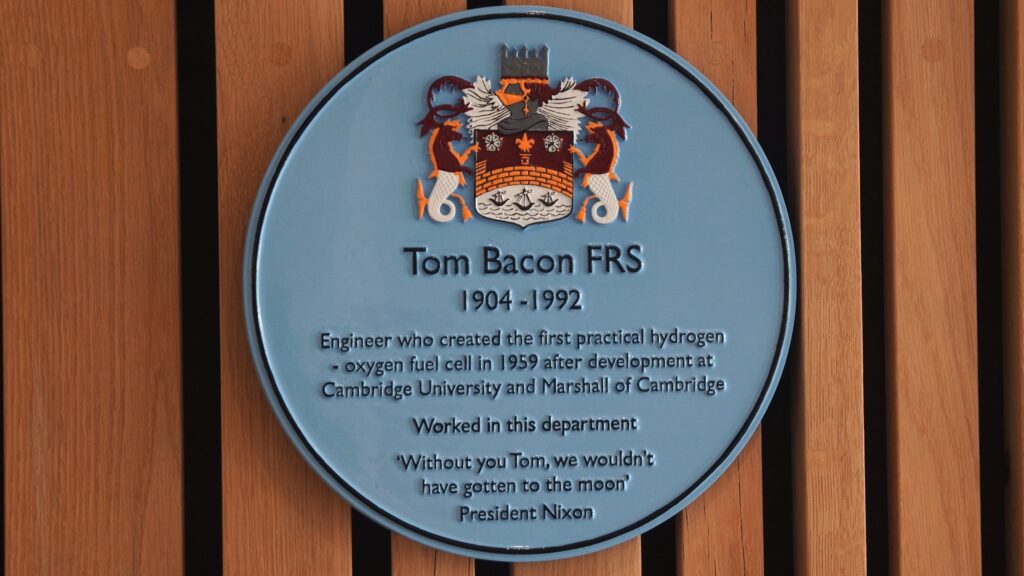
A blue plaque commemorating Tom Bacon’s work was installed at the Department of Chemical Engineering and Biotechnology in November 2024.
Bacon continued working on hydrogen fuel cell technology until his death in 1992 aged 88. He is buried in the village of Little Shelford, just south of Cambridge.