Driven by curiosity. Driving change

Biography

Professor Ross King leads the Machine Intelligence group in the Department of Chemical Engineering and Biotechnology at the University of Cambridge. Professor King is a pioneer in automated science, he created the robot scientists (Adam & Eve) the first machines to autonomously discover scientific knowledge. He is currently building ‘Genesis’ a Robot Scientist designed to automate eukaryotic systems biology.

Professor King built the first nondeterministic universal Turing machine – using DNA.  This new computational paradigm has the potential out-perform electronic computers. 

Professor King obtained his Master’s degree in Computer Science at the University of Newcastle in 1985 and completed his PhD at the Turing Institute (Glasgow) in 1989. The subject was the first application of machine learning to predict protein structure. As a postdoc he developed the first application of machine learning to drug design. He is now one of the most experienced AI researchers in Europe. 

Research interests
  • Automation of science   
  • Drug design  
  • Artificial Intelligence  
  • Systems Biology  
  • DNA Computing 

Professor King’s group researches the interface between artificial intelligence and biotechnology. They are working to develop new machine learning methods for drug design and cancer treatment selection.   He is a founder of the Nobel Turing Challenge: to build a machine able to do Nobel prize quality scientific research autonomously.

Awards and achievements
  • British Computer Society, Machine Intelligence Prize, 2006.  
Teaching and supervision

Ross King is not currently available.

Meet Our Academics

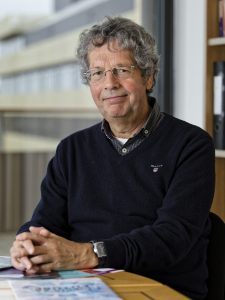
Professor Ross King

Associate Professor

Research Group:Machine Intelligence

Email: rk663@cam.ac.uk

Biography

Professor Ross King leads the Machine Intelligence group in the Department of Chemical Engineering and Biotechnology at the University of Cambridge. Professor King is a pioneer in automated science, he created the robot scientists (Adam & Eve) the first machines to autonomously discover scientific knowledge. He is currently building ‘Genesis’ a Robot Scientist designed to automate eukaryotic systems biology.

Professor King built the first nondeterministic universal Turing machine – using DNA. This new computational paradigm has the potential out-perform electronic computers.

Professor King obtained his Master’s degree in Computer Science at the University of Newcastle in 1985 and completed his PhD at the Turing Institute (Glasgow) in 1989. The subject was the first application of machine learning to predict protein structure. As a postdoc he developed the first application of machine learning to drug design. He is now one of the most experienced AI researchers in Europe.

Research interests

  • Automation of science
  • Drug design
  • Artificial Intelligence
  • Systems Biology
  • DNA Computing

Awards and achievements

  • British Computer Society, Machine Intelligence Prize, 2006.

Professor King’s group researches the interface between artificial intelligence and biotechnology. They are working to develop new machine learning methods for drug design and cancer treatment selection. He is a founder of the Nobel Turing Challenge: to build a machine able to do Nobel prize quality scientific research autonomously.

Meet Our Academics:

  • Professor Clemens Kaminski
  • Professor Dame Lynn Gladden
  • Professor Axel Zeitler
  • Professor Roisin M Owens
  • Professor Geoff Moggridge
  • Professor Sam Stranks
  • Professor Laura Torrente Murciano
  • Professor Ian Wilson
  • Professor Gabriele Kaminski Schierle
  • Professor Lorenzo Di Michele
  • Professor Mick Mantle
  • Professor Andy Sederman
  • Professor Alexei Lapkin
  • Professor Alex Routh
  • Professor Ljiljana Fruk
  • Professor Patrick Barrie
  • Professor David Fairen-Jimenez
  • Professor Sabine Bahn
  • Professor Markus Kraft
  • Professor Ross King
  • Professor Adrian Fisher
  • Dr Sebastian Ahnert
  • Dr Alex Borodavka
  • Dr Graham Christie
  • Dr Ewa Marek
  • Dr Shelly Singh-Gryzbon
  • Dr Akshay Deshmukh
  • Dr Lara Allen
  • Dr Joanna Stasiak
  • Dr Sarah Rough
  • Dr Samuel McDermott
  • Dr Devon Indar
  • Dr Kamran Yunus
  • Dr Zachariah Bond