
 Driven by curiosity. Driving change
Research
Our research covers multiple disciplines under the biotechnology umbrella. Below are summaries of key research projects underway in the group.
Monitoring of viral activity using plasma membrane-conducting polymer chip assembly
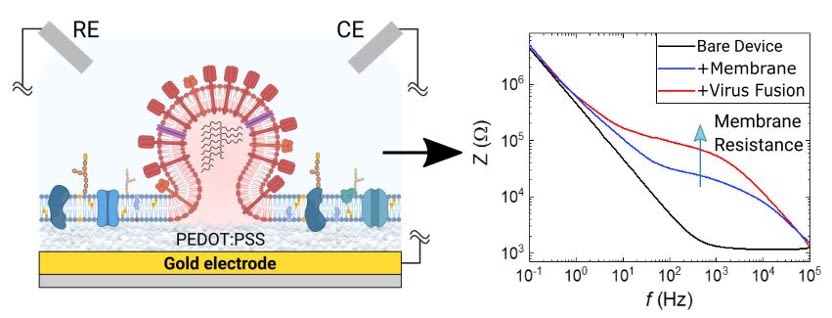
The majority of anti-viral drugs prevent cellular infection by acting on proteins found on host cell membranes.
In this project, we couple native plasma membranes with organic electronic chips to create biosensors that can distinguish between the different stages of viral entry. Our platform uses a label-free electronic readout, combined with conventional optical readouts (fluorescence), to sense the ability of viruses to bind and fuse with host cell membranes, thereby sensing viral entry. Once a virus fuses with our membrane-chip assembly, its membrane merges with the plasma membrane, further inhibiting ion injection to the conducting polymer film.
Our organic electronic chips then transduce this additional ionic barrier to electronic output via conventional electrochemical methods such as electrochemical impedance spectroscopy (EIS). While this platform has been validated for different viruses, including influenza and SARS-CoV-2, our end goal is to develop it into a drug-screening tool to assist and redirect the drug discovery process. This project is funded by the US military agency (DARPA) and is the product of collaboration between the Daniel group at Cornell University and the Salleo group at Stanford University.
Innovative technology solutions to explore effects of the microbiome on intestine and brain pathophysiology
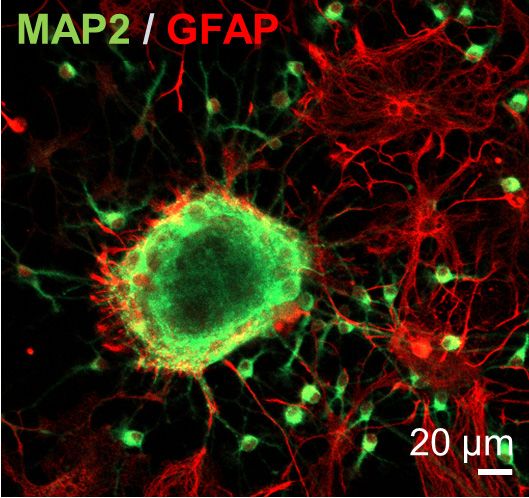
In this project, we are generating in vitro models of the gut and brain with integrated monitoring based on our organic electronics device toolbox.
The completed model will be used to monitor the effects of the microbiome on the gut-brain axis. We are building on former expertise in generating models of the gut for pathogen detection, and also expertise in generating a 3D models of different tissues, including the blood-brain barrier, for toxicology experiments.
Also interfacing with this work is our ability to generate multi-electrode arrays from conducting polymers for monitoring neuronal activity from 2D and 3D cultures.
This is an ERC-funded project which started on 1/10/2017.
Tissue engineering using composite conducting polymer/bio-polymer scaffolds

We have demonstrated the use of electroactive conducting polymer scaffolds for hosting monitoring cells. These scaffolds are easily blended with biopolymers such as collagen which can be used as a tool to modulate biochemical and mechanical properties of the scaffolds.
Thanks to their electrical properties, the scaffolds can be used to stimulate cells electrically which has been shown to alter/enhance differentiation and proliferation of cells under certain conditions.