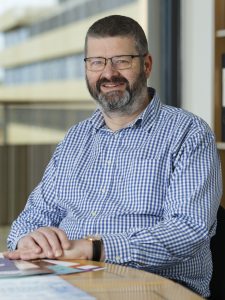
Professor Alex Routh leads the Colloidal Dispersions group in the Department of Chemical Engineering and Biotechnology at the University of Cambridge. His research focuses on colloid science, fluid mechanics, applied mathematics, polymers and encapsulation.
Alex obtained his MEng in Chemical Engineering from the University of Cambridge in 1995, and completed his PhD in Chemical Engineering at Princeton in 2000.
He is a fellow of Gonville and Caius College.
Research interests
Film formation and dispersion drying
Aggregation
Engine oil additives
Encapsulation
Microgels
Professor Routh’s research group delves into both dispersed colloidal particles and materials formed from them. They use their knowledge of their properties to develop bespoke materials for use in areas from drug delivery, surfactants and paints, to sustainable fuels for aviation.
Awards and achievements
Fellow – Gonville and Caius college, Cambridge
Fellow – Royal Society of Chemistry
Fellow – Institution of Chemical Engineers
Member – American Chemical Society
Member – Society of Chemical Industry
Member – International Polymer Colloids Group
Member – International Association of Colloid and Interface Scientists
Most Cited Articles award – Journal of Colloid and Interface Science (2008-2009)
Winner – McBain award (2010)
Science award – Coatings Science International (2012)
Chartered Engineer (2017)
Davidson medal – Institution of Chemical Engineers (2023)
Visiting professorship – Karlsruhe Institute of Technology, Germany (2024)
Thomas Graham Lecturer (2025)
Economic Impact award – ISIS Neutron and Muon Source (2025)
Teaching and supervision
Professor Routhteaches and supervises across undergraduate and postgraduate levels. Courses he teaches include: Colloid science, Mathematical methods; Safety, Health and the Environment, Materials, Process Dynamics and Control, Seperations, Process Enterprise and Logistics, Process Calculations, Process Design, and Heat and Mass transfer.


 Driven by curiosity. Driving change