
 Driven by curiosity. Driving change
Double success for Sensors CDT postgraduates
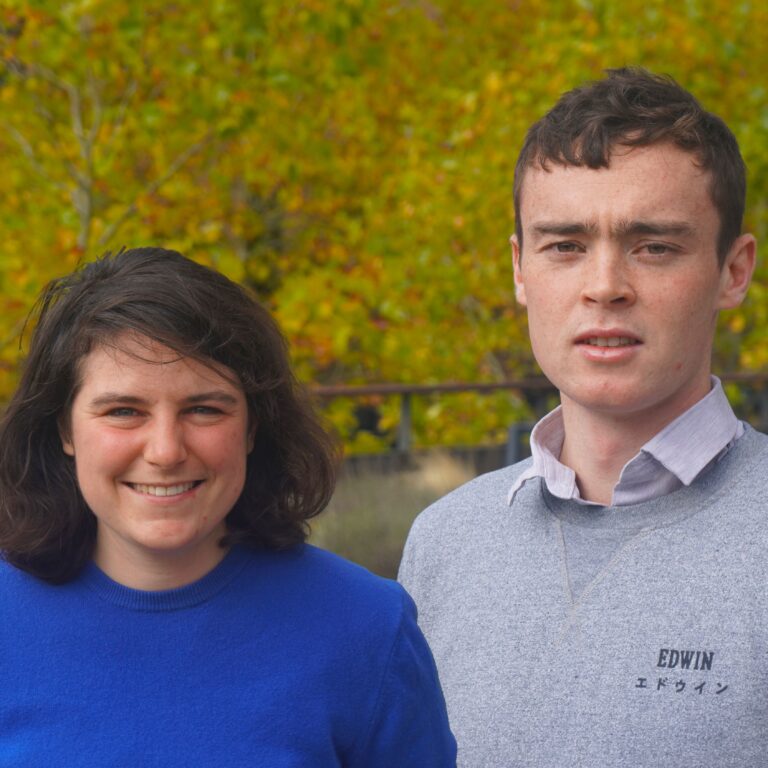
Two fellowships available. Two CEB-linked applicants. Two successes.
Sensor CDT alumni Terry Fawden and Anne-Pia Marty have secured both of the University’s EPSRC Postdoctoral Pathway Fellowships for 2025/26 – a strong result for our department and a clear marker of the strength of the course.
The fellowships are highly competitive, open across all (Engineering and Physical Sciences Research Council) EPSRC-remit departments within the University, and designed to help outstanding PhD graduates take the first step towards independence. Winning both places this year puts the Centre for Doctoral Training’s impact into sharp focus.
Dr Samuel McDermott, Sensor CDT programme manager, said: “This is a fantastic achievement for Anne-Pia and Terry, and a real endorsement of the Sensor CDT model.
“The programme is designed to give students the confidence and technical skills to follow their own research paths, and it’s wonderful to see both of them recognised in this way.”
Anne-Pia, who joined the Sensor CDT programme in 2020, has been awarded 1.5 years’ funding to continue the research behind her project exploring how life can function at zero degrees and below.
The fellowship will allow her to push the work further, refine the science and answer questions that emerged during her PhD.
She said: “I’m really pleased to get this fellowship as it will let me finish what I started – or at least get closer – and allow us to refine what we have,” she said. “It wasn’t my intention, when I first began my PhD, to stay in research, but when the time came, I realised I wasn’t ready to leave yet… I think I would have been very sad to leave now.
“I’m actually really excited to continue this project and the work,” she added. “There’s some pride and it’s nice to have been selected of course – it’s a nice ego boost – but mostly I’m excited to keep going and see where we can take it.”
She added that her PhD also opened her eyes to the gulf between environmental research and environmental policy, an area she now hopes to explore more deeply in this time.
Terry, from the 2021 cohort, will use his fellowship to build the ear-mounted ‘earable’ technology he has been developing at Addenbrooke’s and the Department of Clinical Neuroscience.
These tiny sensors are designed to sit at the ear to track head movement, balance and eye motion, with the aim of diagnosing vestibular disorders faster and more accurately, and eventually providing a rehab tool that could be built into everyday devices such as hearing aids or earphones.
His PhD generated large, complex datasets – including work using ear-worn motion sensors to segment and analyse walking cycles – and the fellowship will give him time to publish several papers and refine the headset system.
Terry said: “It would be able to read people’s movement performance and, if you really struggle, it would be very clear and obvious,” he said. “So it would be a diagnostic tool. It can take 1-2 years for vestibular conditions to be diagnosed, which is mad for something that’s relatively easy to treat… I really think this project could change lives.”
Terry has initially been awarded six months, with the option to extend.
About the programme
The EPSRC Postdoctoral Pathway Fellowships are, typically, one-year positions (with the possibility of extension) open to EPSRC-funded PhD students from across the University. Applicants propose a project that builds directly on their doctoral work and work with both a supervisor and an independent mentor. The University of Cambridge advertised for two fellowships in this latest round.
The two awardees this year both completed the Sensor CDT 1+3 programme, which combines a 1-year MRes based in CEB with a 3-year PhD in any Cambridge department within EPSRC’s remit, provided the project aligns with the CDT’s focus on sensing, measurement and data-driven technologies.