
 Driven by curiosity. Driving change
CASE STUDY
The route to teaching, via industry and Chartered Engineer status
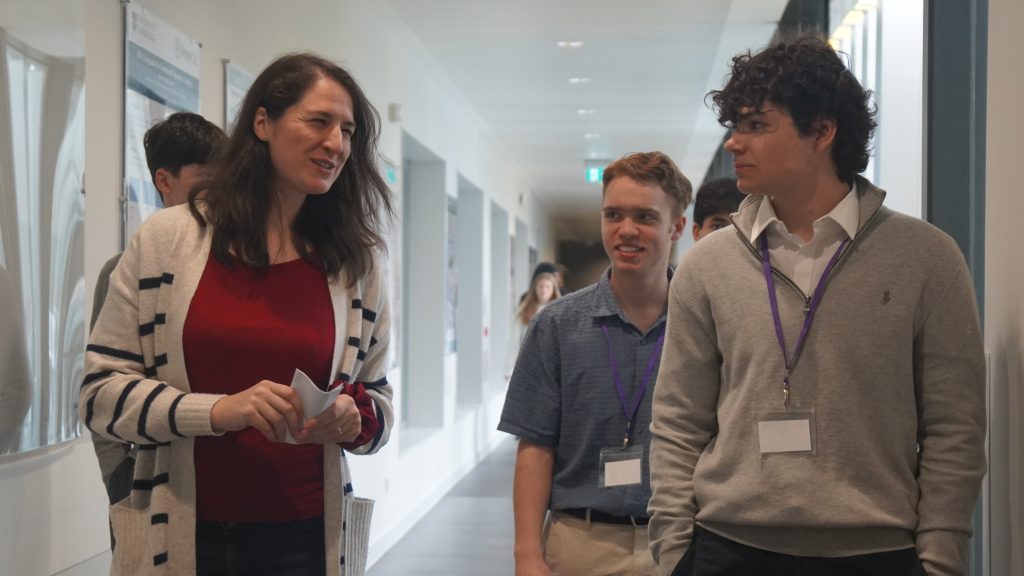
There’s a tendency to think that academic careers follow a neat path – degree, PhD, postdoc, lectureship – but Jelena Brown’s route doesn’t fit that mould.
A PhD candidate in the Particles, Soft Solids and Surfaces Research Group, Jelena returned to Cambridge and academic research after 7 years in industry. During this time, she achieved Chartered Engineer (CEng) status, which not only marked her professional development but also gave her a different perspective to many of her peers.
She hopes to one day take all this knowledge and experience to teach future generations, and be the inspiration that her teachers were to her.
“I have wanted to be a teacher ever since primary school – my first primary school teacher was wonderful and I found that I really enjoyed school from the start,” she said. “I then also had amazing maths and science teachers in secondary school. I had a lot of encouragement at high school.
“But I wasn’t yet thinking about a PhD at this point. I think I only started thinking about doing a PhD myself when I was at university, where all the ‘teachers’ had a PhD.”
Jelena grew up in Zagreb, Croatia, in a school with a strong international outlook, offering the International Baccalaureate at a time when that was far from standard. Although Jelena did the national programme, she appreciates the perspective her school offered.
“It gave me quite an international perspective,” she said. “So when it was time to choose a university, it felt natural to look elsewhere. I had wanted to spend time abroad even before high school.”
Her upbringing had sparked this awareness of different languages and cultures, with a father that has the travelling bug, and speaks multiple languages. Following his example of embracing new places and cultures, and through the encouragement of her teachers, she secured a full scholarship to a university in Pennsylvania, where she spent 4 years, studying chemical engineering.
After graduating, a fully funded master’s in Germany was on the table, but she chose Cambridge instead, joining the MPhil in Advanced Chemical Engineering in 2013 – funding it with a loan. “Cambridge called and I came,” she explained.
“I didn’t know what chemical engineering was before applying [for my undergraduate],” she added. “I just knew I wanted to be doing something with the sciences and something that brought together chemistry, maths and physics. And something that helped the planet.”
She said her worry about climate change, coupled with an interest in sustainable energy, is a big part of what has shaped her career so far, alongside a desire to create something useful.
It was during her BSc that the idea of working in industry took hold.
“My advisor at the time had worked in the pharmaceutical industry before coming back into academia”, she said. “It very quickly got in my head that this is what I wanted to do as well.”
She followed through on that instinct, joining DS Smith and spending seven years in manufacturing, progressing from Graduate Management Trainee to Waste Development Projects Manager. Alongside this, she also worked towards Chartered Engineer status, a qualification that would become a defining part of her professional identity and prove valuable when she later returned to academia for a PhD.
Chartered Engineer (CEng) status recognises engineers who have developed the skills, experience and professional judgement to work at a high level, typically after several years in industry.
For Jelena, it wasn’t just a milestone.
She said: “It was important to me to secure the qualification as a showcase of the hard work and knowledge I had acquired. I also think it gives me credibility and legitimacy in my field, and I think it helped me to secure my PhD offer.
“It has been so helpful to have industry experience among my peers in the research group. I think I have a different perspective and can offer practical, real-world challenges that people might face.
“I often ask ‘why’ as I’m used to having to justify why it’s useful and why it could help. I suppose I am more aware of the limitations of the research, and the budget constraints – the real world doesn’t always have the option to try things.”
Becoming a Chartered Engineer wasn’t an accidental detour from academia, as it now gives her specific insights with doctoral research. Her perspective helps identify what is realistic, what is scalable, and what might be useful beyond the lab. It also feeds directly into how she thinks about teaching.
“When I was at school, I wanted to save the world [editor’s note: Didn’t we all]. I suppose I still want to, but I’m maybe a little more realistic about how I can achieve that,” she said. “I still want to teach. I don’t think the life plan has changed that much, even if I have learned a lot – I can help by inspiring the next generation. As a Chartered Engineer. With a PhD.”